


We see calorie information on food packaging all the time. A product might contain 250 kcal per 100 grams, for example. But where do these numbers come from? Who figured out how much energy food contains, and how did they measure it? And why does the number of calories we consume affect our weight?
The story of calories began long before modern diets and weight-loss apps existed. Scientists carried out some unusual experiments: they burned food in special devices, measured the heat it produced, and then investigated how much energy the human body actually gets from food and what it uses that energy for.
Thanks to this research, we now understand how energy balance works and why a calorie deficit is necessary for weight loss.
What are calories, exactly? To answer that question, we’ll explore how scientists learned to measure food energy, what the laws of physics have to do with body weight, and why actual weight-loss results don’t always match our calculations.
What Are Calories?
A calorie is a unit of energy. Just as we measure distance in meters and mass in kilograms, we can measure energy in calories.
Our bodies need energy to stay alive. It keeps our hearts beating, our muscles contracting, and our body temperature stable. It also powers digestion and countless other processes. Even when we’re asleep or simply lying on the couch, our bodies continue to use energy.
Food is our main source of this energy. It contains proteins, fats, and carbohydrates that our bodies can use for fuel.
But why do we measure energy in calories?
Historically, the calorie was defined in relation to heating water. One calorie is approximately the amount of energy needed to raise the temperature of one gram of water by one degree Celsius.
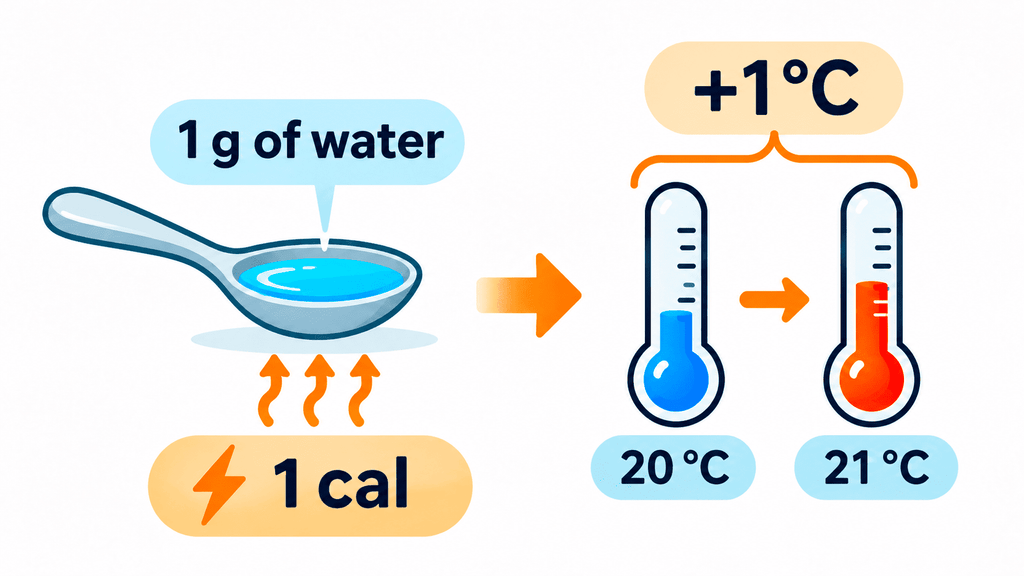
However, nutrition uses a larger unit called the kilocalorie (kcal), which equals 1,000 small calories. One kilocalorie contains enough energy to raise the temperature of an entire kilogram of water by approximately one degree Celsius.
In everyday language, people usually call kilocalories simply calories. So when someone says a food contains 250 calories, they almost always mean 250 kilocalories. In the United States, a dietary Calorie (with a capital C) also refers to one kilocalorie.
Another unit of energy is the joule. In some countries, food energy is listed in kilojoules (kJ). One kilocalorie equals approximately 4.184 kilojoules.
In other words, calories tell us how much energy food contains and allow us to measure how much energy our bodies use.
How Scientists Learned to Measure Food Energy
To find out how much energy food contains, scientists began by literally burning it and measuring the heat released.
The first instruments for measuring heat appeared in the 18th century. For example, French scientists Antoine Lavoisier and Pierre-Simon Laplace conducted experiments using a calorimeter that measured heat by determining how much ice had melted. Over time, these instruments improved, allowing scientists to measure the energy released when different substances were burned with increasing accuracy.
To study food, researchers began using a special device called a bomb calorimeter. Despite its unusual name, the basic principle is fairly simple.
In a laboratory, a small food sample is dried, ground up, and weighed. It is then placed inside a strong, sealed chamber filled with oxygen. The chamber itself is surrounded by water.
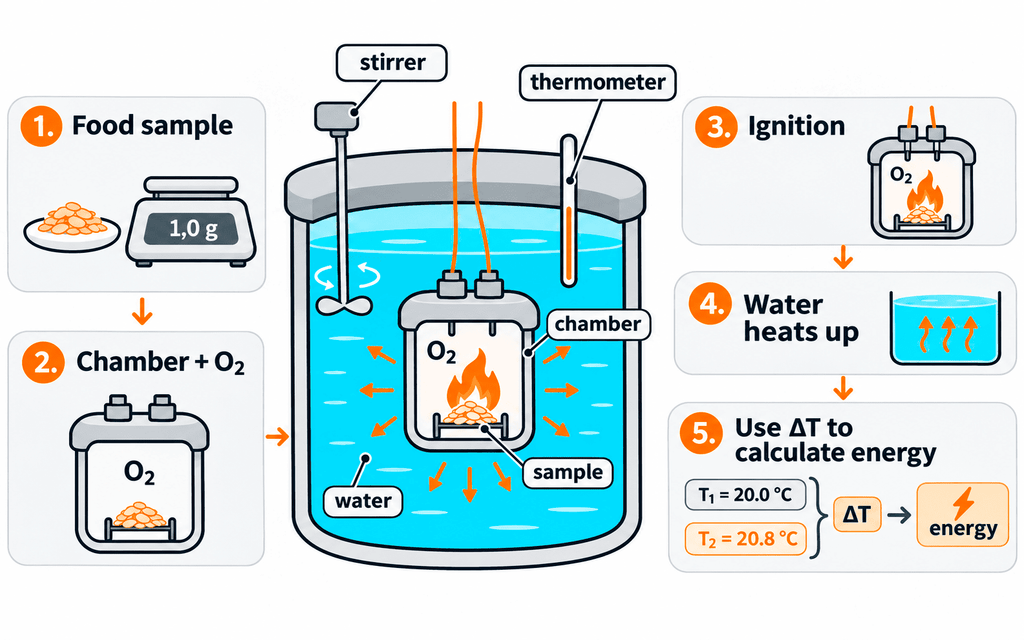
The sample is ignited, and as it burns, it releases heat that warms the surrounding water. By measuring the temperature change and using the known characteristics of the device, scientists can calculate how much energy was released.
Suppose one gram of a dried food sample releases 5 kilocalories when completely burned. This means the chemical energy stored in the sample was converted into heat equivalent to 5 kcal.
This is how scientists can determine the gross energy of food: the amount of energy released when it is completely oxidized.
But this raises an obvious question: we don’t burn food in our stomachs like fuel in a furnace, do we?
Of course not. Inside the body, energy is released gradually through biochemical reactions. What’s more, not all the energy released by burning food in a calorimeter is actually available to the human body.
Scientists understood this difference. Measuring heat in a calorimeter was only the first step. The next challenge was to determine how much energy people could actually use from the food they ate.
Why the Human Body Isn’t a Furnace
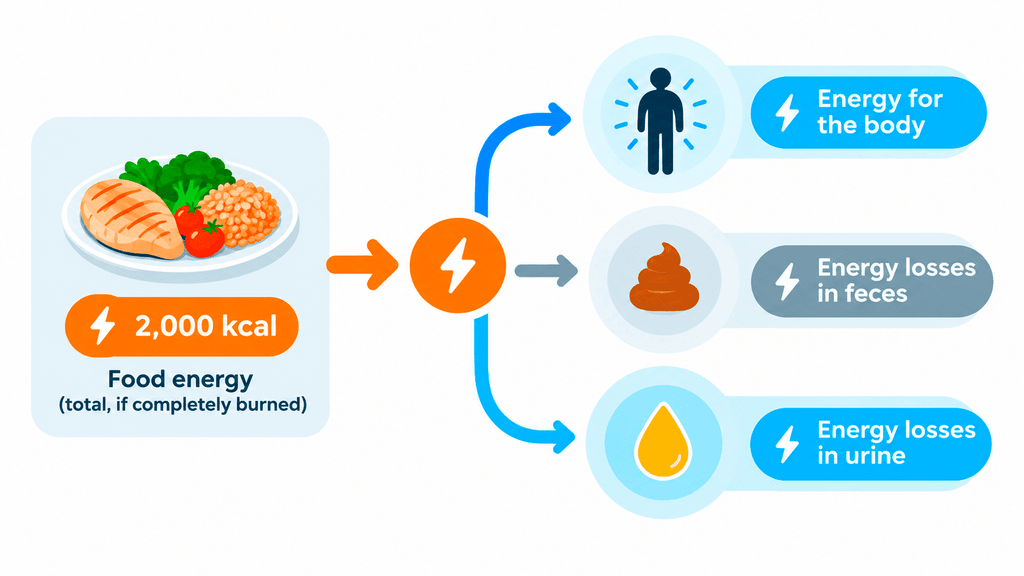
First, food is not completely digested and absorbed. Some of its components pass through the digestive system and leave the body in feces. A certain amount of energy is lost along with them.
Second, even after nutrients have been absorbed, some energy remains in metabolic waste products that are excreted in urine. This is particularly important for proteins: the nitrogen they contain is excreted mainly as urea, which still contains some chemical energy.
But how did scientists figure out how much energy the human body actually gets from food?
Wilbur Atwater’s Experiments
In the late 19th century, American chemist Wilbur Olin Atwater and his colleagues conducted research that helped answer this question.
The researchers recorded how much food the participants ate and what kinds of food they consumed. They then collected and analyzed their feces and urine to determine how much energy and how many nutrients had left the body.
And they didn’t simply weigh these samples. They also analyzed their chemical composition and energy content, including through calorimetry.
This allowed them to compare the energy consumed in food with the energy that was not absorbed or was later excreted.
Let’s look at a simple example.
Suppose all the food someone eats in a day would release 2,000 kcal if completely burned in a calorimeter. However, research shows that some of this energy is lost through feces and urine.
A simplified example of how available food energy is calculated
| Energy in food consumed | 2,000 kcal |
| Energy lost in feces | −120 kcal |
| Energy lost in urine | −30 kcal |
| Energy available to the body | 1,850 kcal |
The energy remaining after these losses is called metabolizable energy. It forms the basis for calculating the calorie content of food because it accounts for the main energy losses associated with digestion and metabolism.
How Calories in Food Are Calculated
Different nutrients provide different amounts of energy. For example, one gram of fat provides the body with more than twice as much energy as one gram of protein or carbohydrate.
What are calories on food labels actually based on? Different nutrients provide different amounts of energy. For example, one gram of fat provides the body with more than twice as much energy as one gram of protein or carbohydrate.
Based on numerous measurements, scientists developed conversion factors that make it possible to calculate the energy content of food. The best-known are the Atwater factors, named after the American researcher we met earlier.
These are the values commonly used in nutritional calculations:
| Nutrient | Energy per gram |
| Protein | 4 kcal |
| Fat | 9 kcal |
| Carbohydrates | 4 kcal |
But why these particular numbers?
Remember the earlier experiments. When one gram of protein is completely burned in a calorimeter, it releases an average of approximately 5.65 kcal. However, the body cannot use all that energy. Some is lost through feces and urine. That’s why nutritional calculations typically use an average value of 4 kcal per gram of protein.
For fat, the difference is smaller: approximately 9.4 kcal per gram when completely burned, compared with 9 kcal in nutritional calculations. For carbohydrates, the corresponding values are about 4.1 and 4 kcal.
The 4–9–4 factors represent average amounts of energy the body can obtain from these nutrients, rather than simply the energy released when they are burned in a laboratory.
How does this work in practice?
Let’s say 100 grams of a particular food contains:
- 10 g of protein
- 10 g of fat
- 20 g of carbohydrates
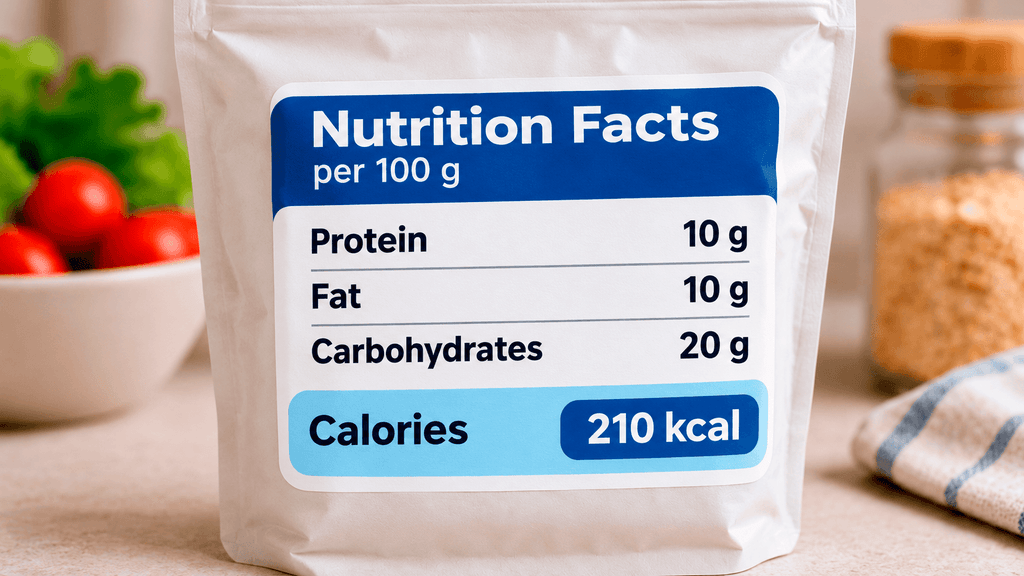
To calculate its calorie content, we simply multiply the amount of each nutrient by its corresponding energy factor.
| Nutrient | Calculation | Calories |
| Protein | 10 × 4 | 40 kcal |
| Fat | 10 × 9 | 90 kcal |
| Carbohydrates | 20 × 4 | 80 kcal |
| Total | 210 kcal |
So, 100 grams of our hypothetical food contains approximately 210 kcal.
This is the basic principle used to calculate the calorie content of many foods. There’s no need to burn every product in a calorimeter. We just need to know its nutrient composition, which can be determined through laboratory analysis, recipes, or food composition databases.
This approach is still used today. For example, the USDA’s FoodData Central database uses both general Atwater factors and more specific factors for certain foods.
Of course, the 4–9–4 formula is a simplification. Foods may contain other sources of energy, such as dietary fiber, and the amount of usable energy provided by the same nutrients can vary slightly between foods.
That’s why the calorie content listed on food packaging is a scientifically based estimate, not an exact measurement of how much energy every individual will obtain. We’ll return to the reasons for these differences later.
How Scientists Measure Energy Expenditure
Imagine a person inside a small, enclosed room. They can rest, read, eat, or exercise while scientists use specialized equipment to measure how much energy their body uses.
Experiments like these began in the late 19th century.
Wilbur Atwater, whom we’ve already met, worked with physicist Edward Rosa to develop a special device called a respiration calorimeter. It allowed researchers to measure the heat produced by a person, along with their oxygen consumption and carbon dioxide production.
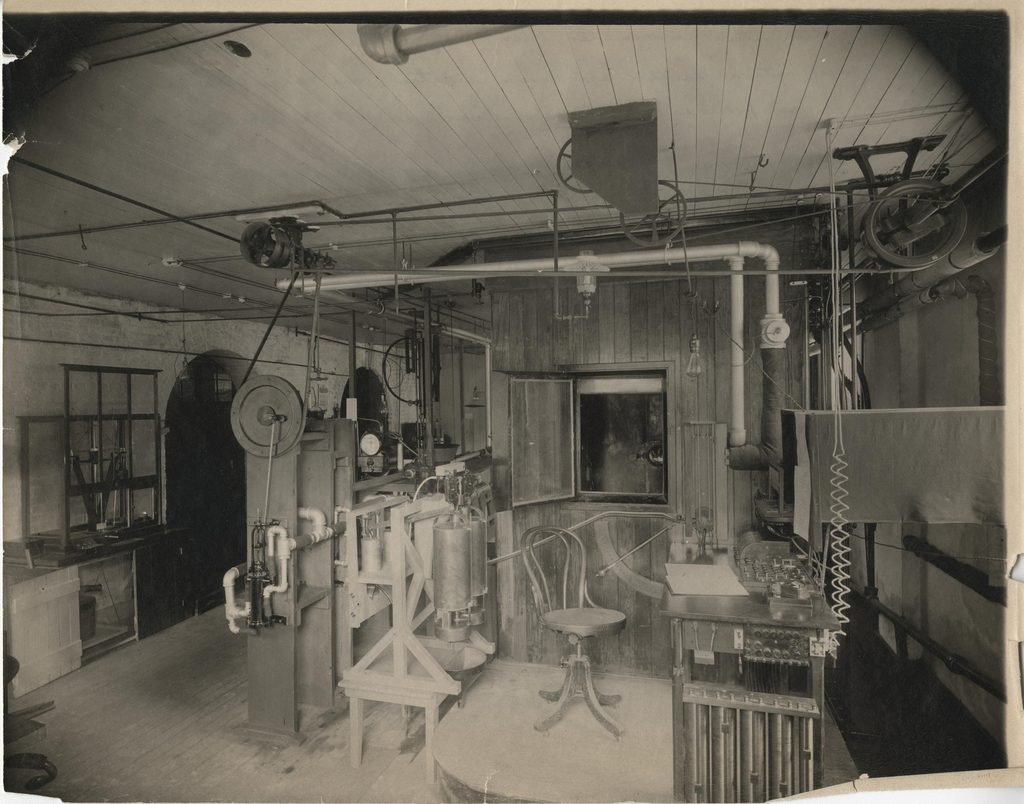
Using these experiments, scientists studied how much energy people expended while resting, sleeping, and performing physical work.
But how can we determine energy expenditure by measuring heat or breathing?
The first approach is to measure heat production. Our bodies constantly release heat into the surrounding environment. A specialized calorimeter can measure this heat and use it to estimate the body’s energy expenditure.
This method is called direct calorimetry. When a person performs physical work, the mechanical work they do must also be taken into account to determine their total energy expenditure.
The second approach is to analyze breathing. When the body uses nutrients for energy, it consumes oxygen and produces carbon dioxide. By measuring these gases, scientists can calculate how much energy the body has used. This method is called indirect calorimetry.
For example, when the body consumes one liter of oxygen during metabolism, approximately 4.7–5 kcal of energy is released. The exact value depends on which nutrients are being used for fuel.
If a person at rest consumes 15 liters of oxygen in one hour, their energy expenditure during that time would be approximately 70–75 kcal. This is a simplified example. For a more accurate calculation, scientists also consider the amount of carbon dioxide produced.
Today, similar measurements can be performed using a special mask connected to a gas analyzer. This allows researchers to assess energy expenditure both at rest and during exercise.
There are also methods for estimating energy expenditure during everyday life over several days. One example is the doubly labeled water method. A person drinks water containing safe, nonradioactive isotopic tracers. Researchers then measure how quickly these tracers leave the body and use this information to calculate total energy expenditure.
What Does the Body Use Energy For?
Thanks to these studies, scientists have established that daily energy expenditure has three main components:
- Resting energy expenditure. The energy needed to keep the body functioning even when we’re not physically active. For most people, this is the largest component of daily energy expenditure.
- The thermic effect of food. The body also needs energy to digest, absorb, and process nutrients. This is a separate energy cost and should not be confused with the energy lost through feces and urine.
- Physical activity. This includes more than just workouts. Walking, household chores, moving around, and all other daily movements contribute to energy expenditure.
The relative contribution of these components varies from person to person. It also changes with lifestyle, body size and composition, diet, and activity level.
Modern methods therefore allow scientists to do more than simply guess how much energy a person uses. They can measure energy expenditure under specific conditions and estimate total energy expenditure over longer periods.
How Energy Balance Works
Now we know how scientists determine the amount of energy people obtain from food and how much energy their bodies use. But what happens when these amounts don’t match?
To answer that question, we need to understand one of the fundamental laws of physics: the first law of thermodynamics.
It states that energy cannot be created from nothing or simply disappear. It can only be transferred or transformed from one form into another. The human body follows this law just like any other physical system.
When we obtain energy from food, our bodies use it to support organ function, movement, body temperature regulation, and countless other processes. Most of the energy we expend eventually leaves the body as heat. Some energy can also be stored, primarily as body fat, but also as glycogen and proteins in body tissues.
This brings us to the concept of energy balance: the relationship between the energy we take in and the energy we expend.
There are three possible situations:
- Energy balance. On average, energy intake is roughly equal to energy expenditure. The body’s total energy stores remain relatively stable.
- Energy surplus. The body takes in more energy than it expends. The difference increases its energy stores.
- Energy deficit. The body expends more energy than it takes in. The missing energy must come from its existing stores.
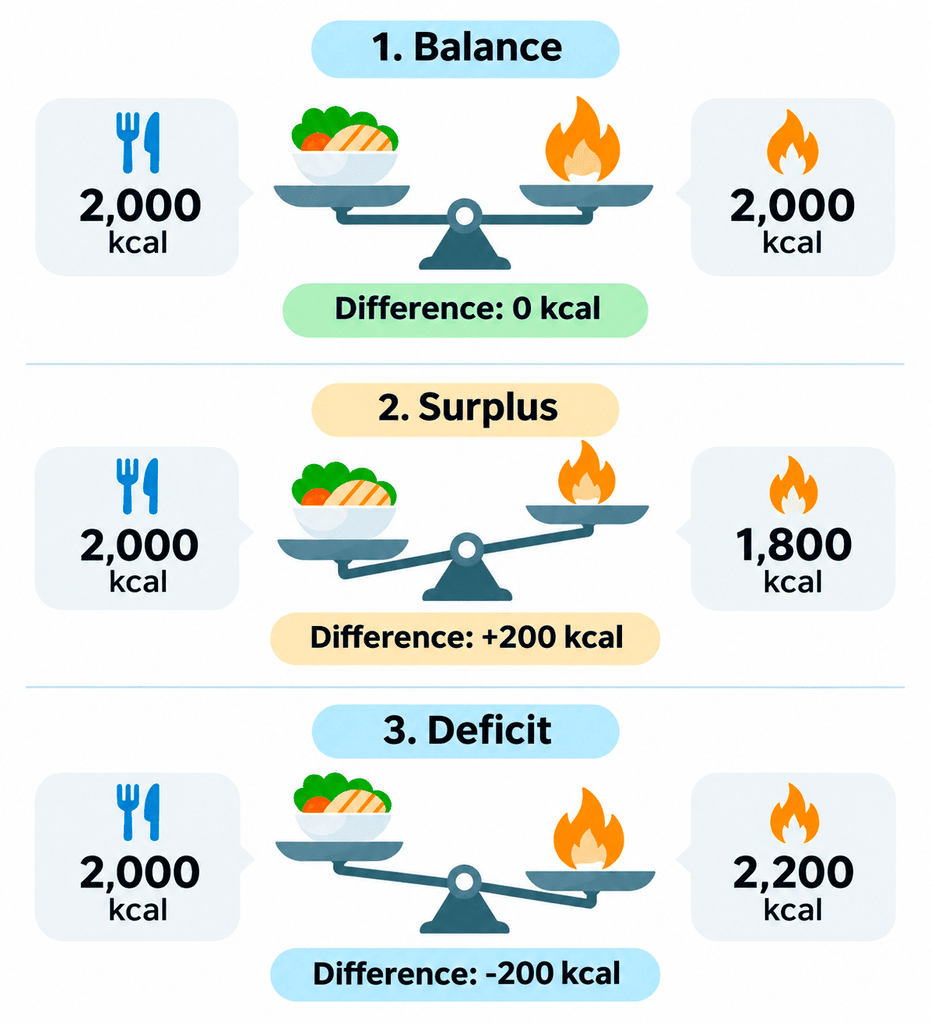
Let’s consider a simple example.
Suppose someone obtains 2,000 kcal of usable energy from food in one day but expends 2,200 kcal.
Where will the body get the missing 200 kcal? From its own energy stores. After all, energy cannot appear out of nowhere.
But this doesn’t mean the person will necessarily lose a specific number of grams of body fat that day. The body uses different energy stores, and changes in body weight depend on more than fat tissue alone.
What Does the Research Show?
The effects of energy balance on body weight have been studied in numerous experiments. Scientists have changed participants’ calorie intake, measured their energy expenditure, and observed how their weight and body composition responded.
For example, the CALERIE-2 study included 218 adults who were assigned to two groups. One group was instructed to reduce their calorie intake by 25%, while the other continued eating without specific restrictions.
The study lasted two years. During this period, participants in the calorie-restriction group actually reduced their energy intake by an average of approximately 12%. They lost about 7.6 kg of body weight, including approximately 5.4 kg of fat. In the control group, average body weight remained virtually unchanged.
This is a clear example of how sustained reductions in calorie intake can lead to a decrease in body fat stores. However, the researchers also found that participants lost some fat-free mass along with the fat.
It’s important to understand that an energy deficit is not a particular diet or a calorie-counting method. It’s a state in which the body receives less usable energy than it expends.
Why Calorie Calculations Don’t Always Match Reality
Imagine you’ve calculated your daily energy expenditure at 2,500 kcal and decided to eat 2,000 kcal per day to lose weight. That gives you a calculated deficit of 500 kcal a day. But a week goes by, and the number on the scale has barely changed.
Does that mean calorie deficits don’t work? No. The problem is that calculating energy intake and expenditure with absolute accuracy is difficult. And changes in body weight don’t always reflect changes in body fat.
Let’s look at the main reasons.
1. Food calorie values aren’t perfectly accurate.
In the previous sections, we explored how the energy content of food is calculated. However, standard conversion factors cannot account perfectly for the characteristics of every food.
For example, in a 2012 study, researchers investigated how much energy people actually obtain from whole almonds. The study included 18 adults who consumed diets containing different amounts of almonds. Researchers measured the energy content of the food and the energy lost through feces and urine.
They found that a 28-g serving of almonds provided an average of approximately 129 kcal of metabolizable energy, compared with the 168–170 kcal predicted by the Atwater factors. One reason for this difference is the structure of nuts. Some of their fat is trapped inside plant cells and isn’t fully accessible to digestion.
2. We don’t always track what we eat accurately.
Even when someone records everything in a food-tracking app, they may misjudge portion sizes or forget about cooking oils, sauces, drinks, or small snacks.
For example, a 2019 systematic review of 59 studies involving 6,298 adults found that people frequently reported consuming fewer calories than would be expected based on measured energy expenditure.
This highlights how common it is to underestimate food intake.
3. Energy expenditure constantly changes.
Calorie calculators provide estimates based on factors such as height, weight, age, and physical activity level. But a person’s actual energy expenditure may differ from the calculated value.
As people lose weight, their bodies also generally require less energy. A lighter body uses less energy for certain movements, and some people may unconsciously become less active throughout the day.
Additional metabolic changes can also occur as the body adapts to reduced energy intake. The extent of these adaptations varies between individuals. As a result, a calorie deficit that existed at the beginning of weight loss may become smaller over time, even if calorie intake stays the same.
4. Body weight changes for reasons other than fat loss.
Bathroom scales measure total body weight, including water, muscle, fat, and the contents of the digestive tract.
For example, after eating salty foods or changing carbohydrate intake, the body may temporarily retain more water. In women, changes in body weight can also be related to the menstrual cycle.
This means that even when body fat is genuinely decreasing, the number on the scale may stay the same for several days or temporarily increase.
It’s also important to remember that hunger, fullness, and energy expenditure are partly regulated by hormones and the nervous system. These mechanisms influence how much we eat, how actively we move, and how the body responds to weight loss. They don’t override energy balance, but they help explain why maintaining a calorie deficit can be difficult.
So, a calculated calorie deficit doesn’t always match the actual deficit, and changes in fat mass can be temporarily hidden by fluctuations in water and other components of body weight.
How to Use This Knowledge for Weight Loss
Now that we understand what calories are and how energy balance works, there’s a practical question to answer: Do you really need to count every calorie you eat to lose weight?
No. Calorie counting is just one tool for managing food intake. You can also lose weight successfully without counting calories by changing your eating habits and physical activity levels.

For example, someone might stop drinking sugary beverages every day, slightly reduce their portions of high-calorie foods, and start walking more. They may not know exactly how many calories they’ve saved or burned, but these changes can help them create an energy deficit.
Choose a way of managing your diet that works for you.
If you like numbers and prefer a more structured approach, you can calculate your calorie intake and track the foods you eat. If not, focus on portion sizes, regular eating habits, and choosing foods that help you manage hunger and fullness.
But how many calories do you actually need?
The same 2,000 calories per day might create a deficit for one person and a surplus for another. To estimate your individual energy needs, try the SimplaFit Calorie Calculator. It takes your sex, age, height, weight, and physical activity level into account to estimate how many calories you need for weight loss, weight maintenance, or weight gain.
You don’t have to eliminate your favorite foods.
There’s no need to completely give up bread, sweets, fats, or other foods you normally enjoy. What matters more is maintaining a nutritionally balanced diet and choosing changes you can stick with over time.
Don’t forget physical activity.
Walking, cycling, swimming, and other forms of physical activity increase energy expenditure and help you stay fit.
Strength training is especially useful during weight loss because it helps limit the loss of fat-free mass, which includes muscle.
If you’re new to exercise, our guide on how to start fitness training can help you build a routine that suits your current fitness level.
Evaluate your results in practice.
Any calculation of calorie intake or energy expenditure is only a starting estimate. To find out whether your chosen approach is working, monitor changes in your body weight and waist circumference.
Weigh yourself under similar conditions, such as in the morning after using the bathroom, and compare your results over several weeks. If your weight is gradually decreasing and you feel well, the changes you’ve made are probably helping you move toward your goal.
If there is no consistent downward trend after several weeks, review your diet, physical activity, and the accuracy of your estimates. You may need to make small adjustments to your habits or calorie intake. There’s no need to immediately resort to severe restrictions.
Finally, remember that calories help explain changes in the body’s energy stores, but they don’t tell us everything about the nutritional quality of food. Two diets with exactly the same calorie content can differ considerably in their amounts of protein, fiber, vitamins, and minerals, as well as how filling they are.
The goal, then, isn’t to spend your life counting every calorie. It’s to learn how to manage your eating habits and physical activity in a way that helps you gradually reach your desired weight and maintain your results.
Conclusion
Calories aren’t arbitrary numbers invented by dietitians. They are based on real scientific experiments, measurements, and calculations that researchers continue to refine. Thanks to this research, we understand how much energy we obtain from food, how our bodies use it, and how this relates to changes in body weight.
Energy balance follows the laws of physics, but the human body is far more complex than a simple calculator. That’s why it’s important not only to understand the principle of an energy deficit but also to consider eating habits, physical activity, and individual differences.
And most importantly, understanding calories doesn’t mean you have to count them all the time. This knowledge is primarily about making informed decisions about food, separating scientific facts from misconceptions, and finding a realistic way to reach and maintain your desired weight.